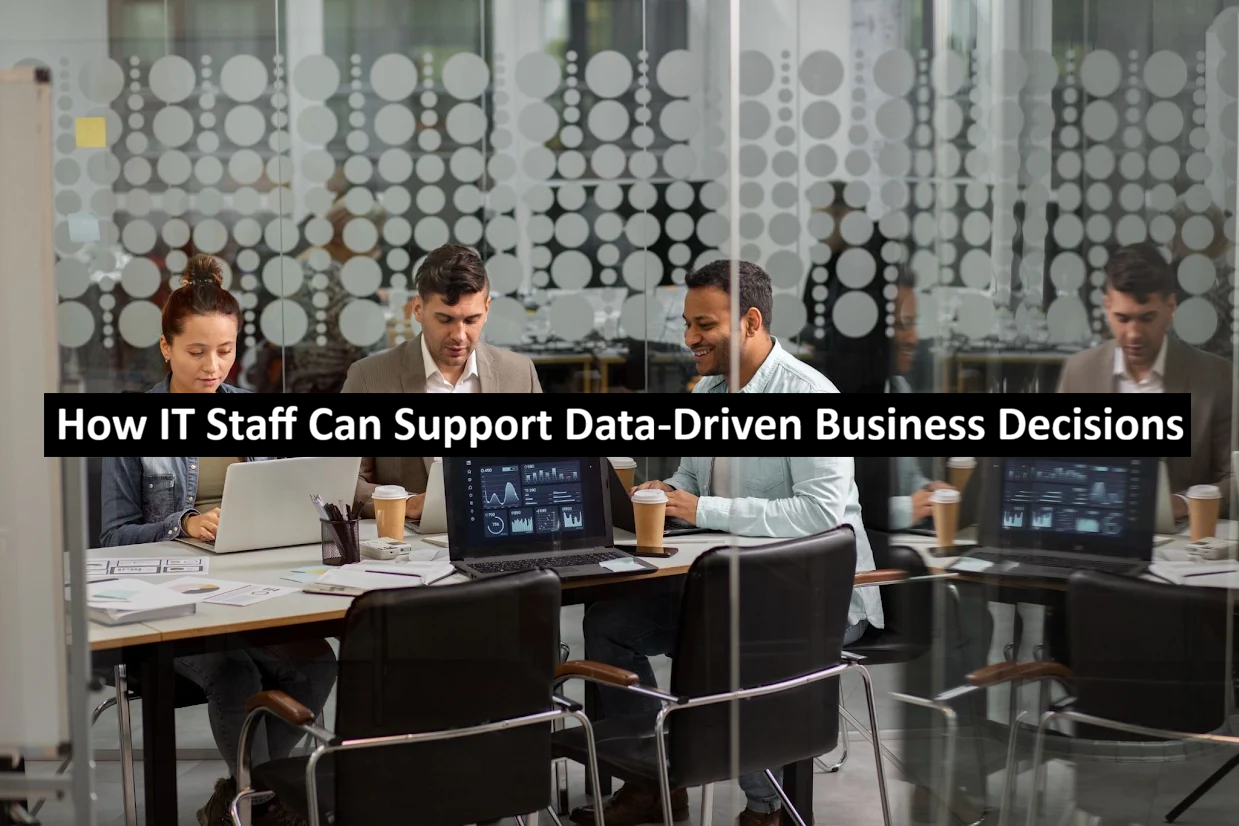
In today’s digital economy, companies generate vast amounts of data every day, ranging from customer conversations and sales transactions to internal operational processes and market signals. But well… data by itself doesn’t really turn into real value. The whole point is how it gets reshaped into usable insights, the kind that actually push strategic decisions forward.
That’s where IT staff start to matter a lot. IT people aren’t just stuck maintaining systems and infrastructure anymore. They basically act as key catalysts for data-driven decision-making.
When they manage data platforms, keep data quality in check, and make room for advanced analytics, IT teams help organisations reach better, more precise, and faster business choices.
In this article, we’ll examine how IT staff support data-driven business decisions through technology, established routines, and effective teamwork.
Read: 12 Things You Must Do Some time recently Beginning a Business
Understanding data-driven decision-making
Data-driven decision making, sometimes abbreviated as DDDM, is the practice of making business decisions based on analysis of data, rather than relying solely on intuition or simple guesswork.
Companies use the data to notice tendencies, anticipate what might happen, and fine-tune everyday operations.
For Example:
Sales groups use the data to track customer purchasing patterns in real life, not just in theory. Marketing groups also watch how campaigns performed, and they rely on those performance measures. Finance groups then work to estimate revenue from prior records.
But without the right IT help—like actually gathering the data, processing it, and then analysing it—this whole idea would get messy, slow, and frankly not very efficient, either.
Role of the IT team in the data framework
The IT team has an indispensable role in a data architecture through the provision of security, data infrastructure management, data quality maintenance, and integration. An IT team makes a significant contribution towards the implementation of data management tools and ensures that there is reliable access to the data for informed decision-making within the organisation.
It is as if they are always on duty, ensuring that everything is balanced even amidst chaos or when different systems need to communicate at once.
Building and running data systems
The IT staff handle the job of designing and keeping up the infrastructure that stores, then processes, all the data. Basically, they work with the components that make data usable. This covers things like
– Databases, for example, SQL and NoSQL
– Data warehouses, where information gets gathered
– Cloud storage platforms
– Data lakes, for keeping bigger and more varied collections
With these setups in place, data stays available and can grow; it also stays reachable, right when it is required.
Keeping the systems dependable
If teams want data-led decisions to actually work, the underlying systems have to be dependable. So IT groups watch over.
- Uptime, so services stay online.
- Performance tuning to reduce slowdowns
- Backup plans and disaster recovery, in case something goes wrong
When a data system fails, the outcome can be pretty serious. It may cause wrong conclusions, or you can end up missing opportunities that were, maybe, obvious from the data.
Data Collection and Integration
Data collection from multiple sources is, well, usually everywhere.
For instance, businesses gather information from Websites and mobile apps, CRM systems, ERP systems, and also IoT devices. Then IT staff, if they are doing it right, set up a smooth routine for gathering that data using APIs, integrations, and those automation tools that sort of “just handle it”.
After the collection comes the whole data integration part. Raw data can show up in different formats and sit inside different systems, so IT teams end up merging it into one centralised place.
And the main result is that integration helps keep things consistent, and it reduces those stubborn data silos, where teams end up working with mismatched information.
Data Security and Privacy
The two concepts, data security and data privacy, are an integral part of any data architecture, acting as a shield that protects your sensitive data from being accessed or compromised.
These two concepts will help you adhere to the regulations, protect the trust of the users, and implement security measures such as encryption, access control, and monitoring of data integrity and confidentiality.
Protecting Sensitive Data
When organisations rely on data-driven decisions, data security becomes critical. IT staff typically put in place things like
- Encryption
- Access controls
- Authentication mechanisms
And this is what shields sensitive business data and customer information.
Facilitating Real-Time Decision-Making
Today’s businesses need real-time information. The IT department ensures:
- Real-time information processing
- Real-time dashboards
- Real-time alerts
With this, businesses can react immediately to:
- Changes in the market environment
- Consumer behavior
- Operational issues
Integration of Automation and Artificial Intelligence Tools
The use of automation and AI technologies improves the effectiveness and scalability of data architecture. Such technologies automate routine operations and allow companies to make better decisions based on data and improve their performance.
The IT staff integrates automation and artificial intelligence tools that:
- Analyse real-time information
- Perform some actions according to certain rules
- Make suggestions
Collaboration with Business Teams
Collaboration between business teams will help ensure that the data initiatives somehow align with the organisational goals and that they produce some value instead of reports.
Once both sides know what is expected from them, the IT team, along with the data professionals, can come up with solutions that would enhance the usability of the data and drive proper decision-making throughout the organisation. It may sound quite easy, but it’s really important.
Bridging the gap between IT and business
IT staff need to team up closely with the business groups, so they can really see what the needs are. In practice, this means doing things like
- figuring out the key metrics
- building dashboards that actually match the use case
- Adjusting data solutions so they fit the workflow
Problems Faced by the IT Team
Although IT team members play an important role, in reality, they also face a variety of challenges. First of all, the issue of data silos exists in practice, meaning that each department stores its information separately, which makes the integration process more complicated than it should be.
Besides, the threat of the security risk never goes away, because cyber-attacks and data breaches always lurk behind the scenes.
Moreover, there is an aspect of fast-changing technologies pressure, which means that the IT team constantly has to acquire new knowledge.
Best Practices for IT Staff
If you want data-driven decisions to actually work in the real world, IT staff should probably stick to a few solid routines, even when things get busy. Here’s a sort of practical list that tends to help.
Implement strong data governance.
That means, set up well-defined rules for data handling, safety, and how it can be used in day-to-day operations.
Use scalable technologies
Try cloud-based platforms and other expandable solutions, so your setup does not choke when data needs grow, or when workloads shift without warning.
Focus on user-friendly tools.
Pick approaches that non-technical folks can understand without turning everything into a seminar.
Encourage collaboration
The IT team should work closely with business teams to ensure that the IT side and business objectives remain aligned, rather than drifting apart.
Finishing Words
IT professionals are important for making data-driven decisions in a business setting. By constructing proper data infrastructures and guaranteeing data quality, they provide stability and security; by conducting analytics, they help organisations move forward. These efforts are necessary in the modern business environment, particularly in the case of risks involved. Many organisations also rely on IT Staff Augmentation Services to quickly access skilled professionals who can strengthen their data capabilities and support critical business initiatives.
With data becoming an ever more important factor for the strategic development of organisations, the role of IT will continue to grow. The adoption of proper technologies, processes, and approaches to cooperation will allow IT professionals to assist organisations in making better and faster decisions.
In a world that runs on data, IT plays a vital role as a strategic business partner.
Author’s Bio:
Harikrishna Kundariya, is a marketer, developer, IoT, Cloud & AWS savvy, co-founder, and Director of eSparkBiz, a Software Development Company. His 15+ years of experience enables him to provide digital solutions to new start-ups based on IoT and SaaS applications.
About the Author